


North Carolina Professional Liability: 2026 Guide
North Carolina malpractice insurance costs and coverage options vary by medical specialty, practice setting, claims history, policy structure, limits, and other underwriting factors. Although North Carolina does not generally require physicians to carry medical malpractice insurance by statute, hospitals, employers, healthcare facilities, and credentialing organizations may establish their own coverage requirements.
Understanding North Carolina malpractice laws, insurance costs, coverage structures, and carrier options can help physicians and practice leaders make informed professional liability decisions.
North Carolina physicians have access to a competitive malpractice insurance market that includes regional and national insurers. Both claims-made and occurrence coverage may be available depending on the physician, specialty, insurer, and underwriting.
Important considerations for North Carolina physicians include:
- Medical specialty and procedures performed
- Practice setting and employment arrangement
- Claims history
- Policy structure
- Coverage limits
- Prior coverage and retroactive date
- Hospital or facility requirements
Higher-risk specialties such as obstetrics, neurosurgery, and other surgical fields typically face substantially higher premiums than primary care and non-procedural specialties. Coverage options, underwriting requirements, and pricing can also differ based on employment type and claims history.
This 2026 guide covers North Carolina malpractice insurance requirements, rates, policy structures, insurers, claims data, liability laws, and other factors physicians may want to consider when evaluating coverage.
Medical Liability in North Carolina: What Physicians Should Know
North Carolina combines an active medical liability system with statutory provisions that affect how medical malpractice actions are pursued.
State law includes a limit on certain noneconomic damages, a pre-filing expert-review requirement for most medical malpractice complaints, and specific statutes governing when malpractice actions may be filed.
These provisions can shape the liability environment, but they do not eliminate professional liability exposure. Coverage decisions still depend on factors such as specialty, practice setting, limits, employer requirements, policy structure, and individual circumstances.
Medical Malpractice Insurance Requirements in North Carolina
North Carolina does not generally require physicians to maintain medical malpractice insurance under state law. However, hospitals, healthcare facilities, employers, contracts, and credentialing organizations may establish their own professional liability requirements.
Docshield's existing North Carolina data identifies $1 million per claim / $3 million annual aggregate as standard limits in the state.
The per-claim limit establishes the maximum available for a covered individual claim, while the aggregate limit establishes the maximum available for covered claims during the applicable policy period, subject to policy terms.
Physicians should confirm the requirements of their own employer, hospital, facility, or contract rather than assuming one coverage limit applies to every North Carolina physician.
How Much Is Medical Malpractice Insurance in North Carolina?
There is no single statewide premium for medical malpractice insurance in North Carolina. Rates vary significantly by specialty and individual underwriting factors.
Based on the existing North Carolina rate data used by Docshield, example undiscounted premiums include:
- Family Practice, No Surgery: $14,500 average premium; $6,077 lowest premium
- Emergency Medicine: $27,700 average premium; $15,855 lowest premium
- General Surgery: $36,600 average premium; $15,855 lowest premium
- OB/GYN, Major Surgery: $58,600 average premium; $41,672 lowest premium
- Pathology, No Surgery: $8,600 average premium; $5,285 lowest premium
- Radiology, Diagnostic: $17,600 average premium; $7,664 lowest premium
These figures are benchmarks rather than individualized quotes. Actual premiums depend on specialty, professional activities, location, claims history, limits, policy structure, insurer, and underwriting.
Occurrence vs Claims-Made Malpractice Policies in North Carolina
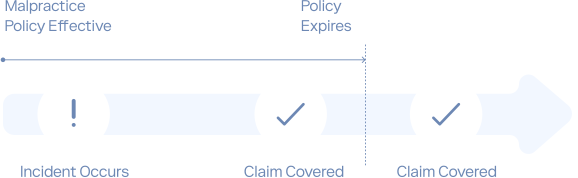
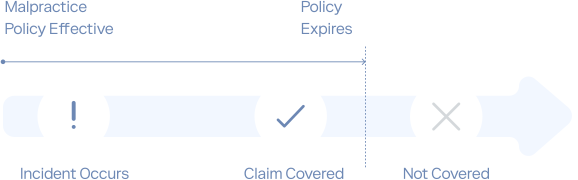
North Carolina physicians may encounter both occurrence and claims-made malpractice policies.
Coverage applies to incidents that occur during the policy period, regardless of when the claim is filed.
Coverage applies to claims filed during the policy period, requiring tail coverage for future claims.
Leading Medical Malpractice Insurance Companies in North Carolina
In addition to the below insurers, DocShield typically provides your practice with quotes from several other highly rated insurers. Ratings provided by AM Best (the leading insurance credit rating agency).
Curi
MagMutual
MedPro
The Doctors Company
Malpractice Insurance Cost in North Carolina
The data below represent examples of undiscounted premiums.
| Medical Specialty | Average Premium | Lowest Premium |
|---|---|---|
| Anesthesiology | $16,800 | $7,664 |
| Cardiovascular Disease - Minor Surgery | $19,600 | $7,622 |
| Dermatology - No Surgery | $6,300 | $4,227 |
| Emergency Medicine | $27,700 | $15,855 |
| Family Practice - No Surgery | $14,500 | $6,077 |
| Gastroenterology - No Surgery | $16,700 | $8,985 |
| General Surgery | $36,600 | $15,855 |
| Internal Medicine - No Surgery | $14,900 | $7,267 |
| Neurology - No Surgery | $18,600 | $8,985 |
| Obstetrics and Gynecology - Major Surgery | $58,600 | $41,672 |
| Occupational Medicine | $11,500 | $3,357 |
| Ophthalmology - No Surgery | $11,500 | $3,593 |
| Orthopedic Surgery - No Spine | $32,800 | $15,855 |
| Pathology - No Surgery | $8,600 | $5,285 |
| Pediatrics - No Surgery | $14,500 | $6,077 |
| Psychiatry | $11,900 | $4,227 |
| Pulmonary Disease - No Surgery | $12,000 | $7,647 |
| Radiology - Diagnostic | $17,600 | $7,664 |
Actual premiums can differ from these figures based on the physician and insurer.
What Affects North Carolina Malpractice Insurance Rates?
Two physicians practicing in North Carolina can receive different malpractice insurance quotes even when they work in the same state.
Insurers may consider factors including:
- Medical specialty: The nature of the physician's specialty and procedures performed can affect underwriting.
- Claims history: Prior claims, incidents, or loss history may influence available pricing and terms.
- Policy type: Claims-made and occurrence policies have different pricing structures and long-term coverage considerations.
- Coverage limits: The limits selected can affect premium.
- Practice profile: Workload, procedures, employment structure, and practice setting may be considered.
- Prior coverage: Retroactive dates, prior-acts needs, and gaps in coverage may affect available options.
- Insurer underwriting: Carriers can differ in how they assess the same physician or practice.
For that reason, an individualized quote is generally more useful than relying on a single statewide malpractice insurance average.
Working with Medical Malpractice Insurance Brokers in North Carolina
North Carolina physicians have multiple insurers, policy structures, and coverage terms to evaluate.
A licensed malpractice insurance broker can help physicians review available carriers, premiums, limits, policy structures, tail provisions, and other relevant terms.
Because independent brokers may have access to multiple insurers rather than representing only one carrier, physicians can evaluate available policies side by side instead of considering price in isolation.
What to Compare in a North Carolina Malpractice Insurance Quote
Premium is important, but it is not the only consideration when evaluating North Carolina malpractice insurance.
- Premium: Quoted cost and applicable discounts
- Coverage limits: Per-claim and annual aggregate limits
- Policy structure: Claims-made or occurrence
- Retroactive date: How earlier professional services are addressed
- Tail provisions: Whether extended reporting coverage may be needed
- Prior-acts coverage: Whether eligible earlier services can be covered by a replacement policy
- Defense provisions: How defense costs are handled under the policy
- Consent to settle: Rights of the physician and insurer regarding settlement
- Exclusions and endorsements: Terms that add, change, or restrict coverage
- Covered practice: Whether specialties, services, and practice locations are accurately represented
The individual policy controls coverage. Physicians should review actual policy terms and discuss questions with a licensed insurance professional before selecting coverage.
North Carolina Claims Payout
Docshield's existing North Carolina claims data provides historical context on medical malpractice payouts in the state.
These metrics provide state-level context but should not be interpreted as predicting the outcome, value, or likelihood of an individual malpractice claim.
Buy Affordable Malpractice Insurance with Docshield
Docshield is designed to reduce the administrative work involved in shopping for malpractice coverage. Physicians can complete a streamlined application, review available options, and receive support from licensed insurance professionals when comparing policies. After coverage is selected, Docshield can continue supporting renewal and market-review decisions as a physician's practice or coverage needs change.
Get a QuoteNorth Carolina Claims Payout
North Carolina Statute of Limitations
North Carolina generally applies a three-year statute of limitations to malpractice actions, measured from the defendant's last act giving rise to the claim.
When an injury or loss is not readily apparent and is discovered, or reasonably should have been discovered, two or more years after the defendant's last act, North Carolina law generally permits an action within one year of discovery. The statute also generally establishes a four-year statute of repose.
A separate provision applies to certain foreign-object cases, and other exceptions or rules can apply depending on the circumstances.
These timelines can affect long-term liability exposure but should not be interpreted as legal advice for any particular claim.
North Carolina's Pre-Filing Expert Review Requirement
North Carolina Rule of Civil Procedure 9(j) generally requires a medical malpractice complaint to meet a pre-filing expert review requirement. The relevant medical care and available records must be reviewed by an individual the plaintiff will seek to qualify as an expert witness. That individual must be willing to testify that the care did not meet the applicable standard, subject to the rule's provisions and exceptions.
This requirement adds a state-specific procedural consideration to North Carolina medical malpractice actions.
Tort Reform in North Carolina
North Carolina has enacted several provisions affecting medical malpractice litigation, including limits on certain noneconomic damages and procedural requirements for malpractice complaints.
Non-Economic Damage Cap
Under N.C. Gen. Stat. § 90-21.19, North Carolina limits noneconomic damages in many medical malpractice actions.
Effective January 1, 2026, the adjusted limit is $712,847. The North Carolina Office of State Budget and Management recalculates the limit every three years according to the statutory inflation formula.
The limit does not apply when the trier of fact makes both findings required under the statute: qualifying injury, such as disfigurement, loss of use of part of the body, permanent injury, or death. The qualifying conduct would need to be classified as reckless disregard, gross negligence, fraud, intentional conduct, or malice.
Voluntary Arbitration
North Carolina also provides a voluntary arbitration framework for certain health care claims when the applicable parties agree to use it.
Because damages rules and litigation requirements can depend on the circumstances of an individual matter, physicians should consult qualified legal counsel for advice about a particular claim.
Tail Coverage for North Carolina Physicians
Physicians with claims-made malpractice insurance may need tail coverage when their policy ends.
Tail coverage extends the reporting period for eligible claims involving professional services provided during the applicable prior coverage period, subject to policy terms.
North Carolina physicians commonly evaluate tail coverage when:
- Changing employers
- Moving between physician groups
- Switching malpractice insurers
- Selling or leaving a practice
- Retiring from clinical practice
When switching insurers, physicians should also determine whether the replacement policy provides prior-acts, or nose coverage, and whether the existing retroactive date will be maintained.
Recent Practice Trends Affecting North Carolina Malpractice Insurance
North Carolina malpractice research provides additional context for physicians evaluating professional liability coverage.
- A peer-reviewed study found that North Carolina's 2011 noneconomic damages cap was followed by significant reductions in malpractice insurance premiums for each of the three physician specialties studied. National Library of Medicine
- A 2024 study involving a large North Carolina orthopedic practice found an 87% reduction in mean annual malpractice claims cost per clinician following implementation of a patient-advocacy and risk-management program. National Library of Medicine
- The same study found an 83% reduction in malpractice claims cost among clinicians identified as high risk following intervention. National Library of Medicine
These findings provide historical and practice-level context rather than predicting the cost of coverage or likelihood or outcome of a claim for an individual North Carolina physician.
North Carolina Resources for Physicians
Physicians researching state-specific licensing, insurance, and professional requirements can find additional information through the North Carolina Medical Board, North Carolina Department of Insurance, and North Carolina Medical Society.
Physicians can also review Docshield's medical malpractice insurance by specialty resources when evaluating coverage considerations for their area of practice.
How Docshield Helps Physicians Navigate North Carolina Malpractice Insurance
Comparing North Carolina malpractice insurance can involve different carriers, premiums, policy structures, limits, and long-term coverage considerations.
Docshield helps simplify the process by:
- Streamlining the malpractice insurance application
- Comparing available options across multiple insurers
- Helping physicians evaluate claims-made and occurrence coverage
- Reviewing tail and prior-acts considerations when coverage changes
- Supporting renewals and coverage changes as practices evolve
This gives physicians a centralized way to evaluate available professional liability options with licensed support rather than navigating each carrier independently.
Compare Medical Malpractice Insurance Options in North Carolina
North Carolina malpractice insurance costs can vary meaningfully by specialty, insurer, policy structure, and individual underwriting.
Docshield helps physicians compare available premiums and coverage terms, including limits, policy type, tail considerations, and other provisions that can affect long-term coverage.